
JNP
Forum Replies Created
-

Dear Moshe,
Thank you for kind reply..
Recently, I have charged the ground water during several days (more than 6 days) with 1 amps to apply to car kit.
When I analyse it there are Fe, Cr, Ni components in charged water even though I could not know the concentration of components.To understand and install Moe-Joe Cell for Car kit, I have checked the viedo \”Water Car Moe-Joe Cell Car Installation Video\” in the website.
I just understand a little bit, the connection part of Moe-Joe Cell into Air intake line. I could not understand it clearly… My question is related on O2 sensor at installation of Moe-Joe Cell. There is an explanation about O2 sensor in the video. I can not understand it clearly.
Should I rearrange or fix O2 sensor line or O2 sensor device ?
If not, does it happens, something wrong?
I want to know it exactly before Moe-Joe Cell installation of car kit.In your website, \”\”This Video Contains instructions on how to assemble the Moe-Joe Cell and Install into the Car via VACUUM intake, and also demonstrates how to get under the car and locate the catalytic converter and the O2 sensors. (note: in this video, we chose a method we are no longer employing the use of – We hooked the two rear O2 sensors together and then we also hooked up the front two O2 sensors together – Also, we are no longer using the Cell Guardian. It DOES NOT WORK – it is a scam. We are sorry if this has misled anyone. The good results we got were exclusively from the Moe-Joe working, and NOT the Cell Guardian… \”\”
These sentences confuse me.. Please let me know the installation method of Moe-Joe Cell for Car kit to understand it easier..
Thank you,
Awaiting your reply.
-
Hi Moshe,
Thank you for your nice comments.
I very appreciate your kind comments to me everytimes.. :laugh:
You said that \” no. the bismuth core shouldn\’t create any scum because it is coated in goop / silicone and is not in contact with the water.
that yellow discoloration is due to nickle and iron coming into the water. \”My question is… This is an assumption. If some silicone part covered bismuth core was peeled a little bit. so, if bismuth core was contacted with water a little bit. Can Bismuth core material reach out into water and can it form any scum or particle? Is it possible to form?
And you said that yellow discoloration is Ni and Fe components coming into the water.
So, I want to do the analysis of this filtered solution components. and also, I want to analyze the filtered solid. Have you ever done the analyasis of this solution and solid? If you give me more information or comment about this, it will be better for my analysis. Please just let me know… 🙂I surprised that a lot of brownish, orangy fluffy scum including some small particle with some precipitations are formed in the charged water when I take out charged water from Moe-Joe Cell after water charging with 1 amps -Method 1, as shown in last message. ((This picture is the same with previous picture of last message, I have just taken photos with high resolution and show you them again.))
Finally, I can use the filtered yellow charged water for healing or car kit after several charge and filter cycles, Is it right?
As you mentioned it, I will compare with the differences of the color and phenomena between the Method 1 with 1 amps and the battery method with low amp.
Thank you,
Awaiting your reply.
Attachments:

-
Hi Moshe,
Thank you so much for your nice comments…
I did the water charging with 1 amp during 2.5 day with VARIAC (Method 1).
I poured the water inside Moe-Joe Cell out. and I found that yellow some particles exist in water. I guess that it come from some Bismuth core.. is it right?
In official web site, you mentioned \”Charge for 1-3 minutes 4-6 times /day until the water gets filled with a brownish, orangy fluffy \”scum.\” then filter the water, using 2 Blue Shop towels (available at Home Depot)\”
I attached the picture. Could you tell me whether it is a brownish, orangy fluffy scum or not? If not what is this? Do you think my experiment is something wrong. Please let me know..
After this water charge, I did filter it. I got filtered yellow color solution. Is it right?
So, I am recharging this filtered yellow color solution for second charge. Is it right?If I did charge it again do you think this yellow some particles in water is not formed?
Please let me know your experiences and comments.
And also I just want to share my AC–>DC converting compact device!
Thank you so much
Awaiting your reply.
Attachments:


-
Hi Moshe,
Thank you very much for your kind reply..
You said that \”very very low would be 0.01 amps, like 10 mA.
0.1 amps = 100 mAs and it is low, but not very very low.\”I measured the currents with different controlled volatage that Moe-Joe Cell device with connected conventional DC charging with VARIAC and bridge rectifyer – Method 1, which is added ground water in Moe-Joe Cell.
When I set AC 33.9V(VARIAC controlling), (converted final DC voltage (with a capacitor) is 39.2V)the current was 1 AMP.
So, I am doing the water charging experiment (5times per day, 1time : charging 5min and then off 2hr) under this condition. (I think that it is not convenient due to on and off everytime.. I mean not continuing.. That\’s why I am asking.. below.. questions)In my measurment, when I set AC 10V the current was 0.06 amp.
I think that this 0.06 amps is low or very low value as you meantioned it above.
When I set 5V the current was 0.002 amp. This must be very very low..So, my questions are…
Instead of 1AMP run on and off (5times per day), can I do the experiment using low value 0.06 amp controlled VARIA C- Method 1 for water charging continuously WITHOUT on and off. Is it ok? Is it possible to charge the water contineously under low current using Method 1? What is the recommendable (low or very very low)current values for contineous water charging?
(If I get the 0.01 amp by controlling the voltage(between 5 and 10V), is it better for long run water charging than 0.06 amps? because 0.01 amp is lower than 0.06 amp. Or is the both case possible?)Also,I get 0.01 amp using the convetional battery with, for example, 7V, is it also ok to use for contineous(long run) water charging without off time ? Or is it better using lower current than 0.01 amp by choosing conventional battery such as 3V etc.?
Have you ever done using conventional battery with 3V or 1.5V for water charging? (If you have a experience, please let me know the period for water charging.)And I have watched surface tention viedo 1 and 2 which you linked last reply. Thank you for this viedo.
By the way, In this case, what was the water charging conditions on the result in this viedos approximately? Times, Current, Method etc.?Thank you so much. (감사합니다.)
Awaiting your reply.
-
Hi, Moshe,
Thank you very much for kind reply.
In your comments, you said that \”so start small and observe the water.
feel the water. do you sense the energy in the water?
do you see an increase in surface tension?\”
I want to know how to feel and observe the charged water in detail.
for example, If I touch it, can I feel the charged water a little sticky ?
How can I sense the energy in the water? How can I see or feel it? and also how to know increase of surface tension.
And, if the scum on the water surface occurs, have the water been charged a little bit?
I am curious about these things. I will do experiment for charging water during 1day ~ 3day.And also you said that \”you may also need to filter the water if it forms scum.\”
After I finish the charging of water, if it forms scums, to remove the scum on the water, can I use a conventional filter paper with shape of round type? Is it right?And also you said that \”if you\’re getting very very very low amps with the 16.6V then you can leave it on a long time, yes.\”
I will check the current during the experiment, what is the value of very very very low amps? 0.01 amp? or 0.1 amp? please let me know the range of very very very low amp.Thank you so much all the time.
Awaiting your reply.
-
Dear Moshe, Sir,
Thank you for kind reply..
Finally, I have a success about bubbling formation!
Another questions is below…
You mentioned that \”yes, you can use baking soda also to increase the current.
then, you must use shorter charging times.
don\’t charge longer than 3-5 minutes at a time.\”I have set up Moe-Joe Cell device with connected conventional DC charging with VARIAC and bridge rectifyer – Method 1, which I showed last time. And I set 80V to check observation of bubbles. (now I do not know the exact current, I just expect 1 AMP approximately, I will check it carefully later.) I found that the bubbles from Moe-Joe Cell come out onto water surface in the platic water vessle.
If I do water charging for healing or for kit enhancer of car fuel efficiency, should I do turn on during 3 min and turn off – this cycles-5 times per a day using Method 1 system controlled 80V? If I do like this I expect that the electric charge (voltage) power will be decreased until next electric charge. That is why I do charge it again. Is it right? Anyway, can I do like this using Method 1 for water charging? If so, How long does it takes to get full healing effect for full water charging? for exampls, 1day or 3 days?? In this case, during overnight should I turn off the power as I sleep in? And I turn on in the morning. Is it right? please let me know about this..And also, you mentioned that it is important to do the water charging at lower voltage (12~20V)than high voltage to see bubbling.
So, I want to try it using conventional battery with 16.6V. If I use this battery can I trun on battery 24 hour without off-time? I mean that is it needed overnight off time? and in this case, how long should I maintain to turn on for water charging to get healing or enhancing something effect? for examples 1day or 3day??Thank you so much.
Awaiting your reply.. -
Thank you for your kind helps.
Another question is below..
I used the distilled water for water changing. Is it ok? Is it possible that it flows the current in distilled water? What kind of water can you recommend it?
Is it possible to use tap water for checking the bubbles or water charging? (instead of distilled water) (I heard that the current can flow in tap water. but it does not flow in distilled water.)
Because I cannot get spring water.(Last time when you answer my question, you mentioned … KOH … .)
If I use NaHCO3(baking soda) solution, what happens? Is it also possible to use it for checking bubbles?To make 1 AMP, which one should I select to use between tap water and NaHCO3 solution if possible.
Thank you.
Awaiting your reply…
-
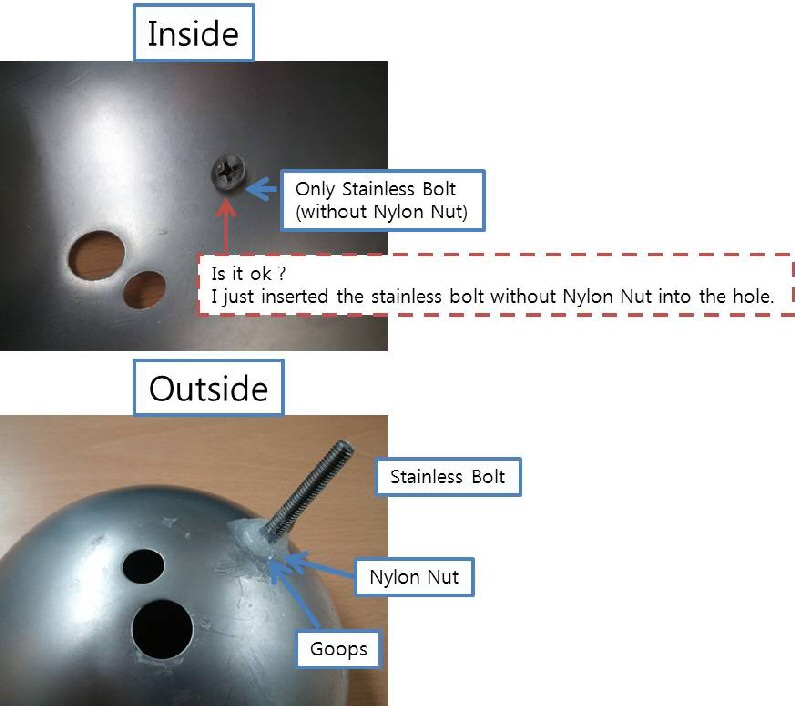
You said that \” it is better to put the nylon cap over the head of the +ve bolt on the inside of the 5\” hemisphere. it will keep all the electricity insulated only to the 5\” hemisphere and not to the head of the bolt, which would otherwise make it the closest element to the inner 2\” -ve sphere.\”
I cannot understand all your reply. Could you tell me more easily? A nylon cap cannot be fixed on + stainless bolt on the inside of the biggest hemisphere. (I mean that A nylon cap cannot be caught in head of the + stainless bolt by itself. I mean that The fitting size is different.)
I just can add a nylon nut in + stainless bolt on the inside of the biggest hemisphere. Can I do like this?
Please tell me your guideline.
I will follow your guideline if I understand it clearly.Awaiting your reply…
Thank you~
Happy New Year~ -
quote :Dear Moshe,
THANK you so much!!!
I will try to do the experiment as you told me.
my attached a zip file (image file) is related on the connection of + stainless bolt inside outside the spacer. Please check it whethere the set-up of connection of + stainless bolt is well done or not.
Awaiting your reply.. If you check this, and then send me the comment, I will do work the experiment immediately.Thank you again.
Awaiting your reply.
Jung-Nam,
it is better to put the nylon cap over the head of the +ve bolt on the inside of the 5\” hemisphere. it will keep all the electricity insulated only to the 5\” hemisphere and not to the head of the bolt, which would otherwise make it the closest element to the inner 2\” -ve sphere.besides that, everything looks good.
quote :P.S. : Whenever I uploaded the JPG image there is a error. So I uploaded a zip file.
(The image file is smal and ok but still it happens uploaded error.)
Sorry about this.Jung-Nam
the error you are getting is because your images are wider than 800 pixels.
i have unzipped each one and reduced them in size to 795 pixels wide (and maintaining aspect ratio)
Attachments:
-
I think that our VARIAC and wire etc. are ok. Only problem is something wrong inside Moe-Joe Cell concerning a electric short. To solve the short problem, we checked the electrical esistant (ohms).
There is a short problem somewhere. So, we seperated all part of Moe-joe Cell.
After that, we checked the electrical resistant (Ohms) as shown in the picture. (Please see attached zip file.)What is the electrical resistant (Ohms) value of Bismuth core connected with thread stainless rod?
our measurment value was 0.480 M ohms (or 0.480 ~ 0.920 M ohms)((indicating that the current cannot flow. is it right?)).
But, in case of after assembling of smallest spacers (closed), the value of Ohms was 2~9 ohms. (It means that the current can flow. Is it right?) What is the ohms value for this case ?I want to know the value of the electrical resistant (Ohms) in case ofyour measurement.
I also found that there is something wrong.
As shown in the attached picture, + part stainless rod is not fixed.
It means + part rod was turned around by itself when I screw + rod.
And also, I can see that there is some empty place inside Bismuth core (arrow part in the picture).After assembling of all part of Moe-Joe Cell, I checked Ohms, but I observed that ohms value is not fixed and faltered in the range of 30~1200 ohms when I touch wire connection part with + part rod. It means something wrong inside Moe-Joe Cell.
Maybe my guess is not true. Anyway, these things is my observation.Please comment and answer my problem and question to solve this short problem.
Thank you. 감사합니다.(= Gam sa hap nee da.)
Awaiting your reply..
-
Thank you.
I still did not solve the high current problem.
(I think that 1 AMP can not be controlled by using our VARIAC. Anyway I should do solve this problem to see bubbling and/or scum from Moe-Joe cell)
(As you mentioned it the important thing is 1 AMP control to check bubbling and/or scum (come out).)
*What is the difference between bubble and scum? what is the different condition to check between bubble and scum?Thank you for your kind comment.
Still I did not do the experiment well…
So I need more your nice comment and answer.Please check the picture attached for your question whether i understand it about your question or not.(you question is that \”did you use all the nylon insulators inside of the cell to surround the threaded bolt going to the inner sphere?\”)
Yes, There is a electric short(short?) when I connect it in the my wrong condition of high current. So I connected the fuse in the wire. But the fuse is disordered when I turn on due to high current as I mentioned previous question (several question).
감사합니다.(= Gam sa hap nee da.) (= Thank you.)
Attachments:

-
Here is the picture of my setup:
I didn\’t use KOH solution I just used only distilled water.
But I could not get 1 AMP. anyway I try to adjust 1AMP.
Please check the picture..
Attachments:


